
About Harmony
- Sales
- Paid
Harmony is an AI voice agent built to handle outbound, inbound, and follow-up calls for revenue and customer service teams at scale. It utilizes a proprietary model designed to drive business outcomes, offering low-latency responses and structured conversation flows. The platform includes tools for lead qualification, appointment setting, analytics, predictive dialing, and customer service automation.
Written by our automated systems from Harmony's own description and website. It is a summary, not a scored review — we publish no rating, score or percentage we did not measure ourselves. The maker of this listing can edit or remove it.
What is Harmony?
Harmony is an AI voice agent platform built to handle outbound, inbound, and follow-up calls for revenue and customer service teams. It operates using a proprietary model designed to drive business outcomes such as lead qualification, appointment setting, and customer service automation. The software delivers low-latency responses and structured conversation flows across multiple industries like insurance, telecom, banking, and healthcare.
Harmony key features
- Sub-400ms median response time and near-zero voice latency around 200ms
- AI SDR for outbound script execution, prospect qualification, and hot-transfers
- Speed-to-lead capabilities to call inbound leads in under 60 seconds
- Predictive, power, and batch dialing via an AI-native dialer
- Smart routing and IVR traversal for inbound intent and external phone trees
- Call analytics, automated QA, scoring, and exportable reports
- A/B-tested intros, disclosures, and objection handling on live traffic
- Cross-call memory that retains qualifying data captured from previous interactions
Harmony pros and cons
Pros
- Strong focus on deterministic, structured conversation flows that reduce rogue promises and hallucinations by limiting LLM use to moments requiring flexibility
- Comprehensive compliance infrastructure supporting SOC Type 2, GDPR, HIPAA, and ISO 27001 standards
- Built-in telephony management features including branded caller ID, local presence calling, and caller ID reputation monitoring
- Continuous optimization capabilities that automatically analyze outcomes and tune scripts based on conversation data
Cons
- The Pay as you go tier is restricted to a maximum of 3 agents, up to 10 concurrent calls, and 100 calls per day
- Caller ID reputation monitoring and remediation features are limited to the US only
- Pricing for the Enterprise tier is not published and requires contacting the sales team for custom quotes
- Advanced insights and white-glove implementation require stepping up to the Enterprise tier
Who Harmony is for
Harmony fits revenue, sales, and customer service teams at scale that need to automate inbound deflection, outbound campaigns, renewals, and win-backs. It suits organizations in verticals like insurance, telecom, banking, travel, and healthcare that require audit-ready accuracy and strict compliance controls. It is a poor fit for casual chat use cases or teams looking for unstructured, free-form conversational bots that do not target specific business outcomes.
Harmony pricing
Harmony offers two primary tiers. The Pay as you go tier is billed by the minute at a rate ranging from $0.07 to $0.39 per minute depending on the voice model, supporting up to 3 agents, 10 concurrent calls, and 100 calls per day. The Enterprise tier provides custom pricing for scaling teams with unlimited agents, custom concurrency, call volume, hot transfers, advanced insights, and white-glove implementation.
What makes Harmony different
Unlike generic conversational chatbots designed for casual chat, Harmony utilizes a proprietary model specifically trained for revenue and customer service outcomes such as qualifying, handling objections, and closing. Rather than relying entirely on a general-purpose LLM to roll dice on every sentence, it runs structured, approved flows and only invokes an LLM when a moment demands flexibility. Additionally, it features an automated self-improving brain that analyzes call data to A/B-test variants and continuously tune scripts on live traffic.
Harmony integrations and compatibility
Harmony integrates natively with CRM platforms including Salesforce, HubSpot, and Monday.com, and provides API access and webhooks.
Is Harmony worth trying?
Harmony is worth trying for revenue and support teams looking to automate high-volume calling workflows with strict compliance and deterministic script control. Teams operating below the limits of 3 agents and 100 calls per day can start on the Pay as you go tier, while larger operations will need to request a custom Enterprise quote. Those without telephony-centric sales or customer service workloads will find little use for the platform.
Harmony alternatives
The sales tools listed here closest to Harmony, by shared categories and tags and by how alike the two descriptions read. Not a ranking against Harmony — open one and judge for yourself.
 Cald.AIAI-powered conversational agents for phone calls
 WonderchatAI customer support and conversion agent platform
 WorkBotAI agents for customer support and voice automation
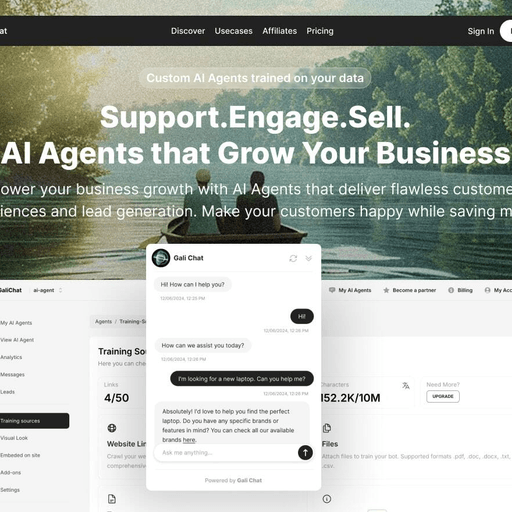 GaliChatCustom AI agents trained on your business data
 SiteGPTAI customer support agent trained on your website
 ChatbaseAI customer experience and support platform
Be the first to comment